Genogram Examples
Genograms come in various sizes and shapes, depending on their purpose. Below you will find examples of various genograms that illustrate a number
of family situations that family trees may not be able to portray.
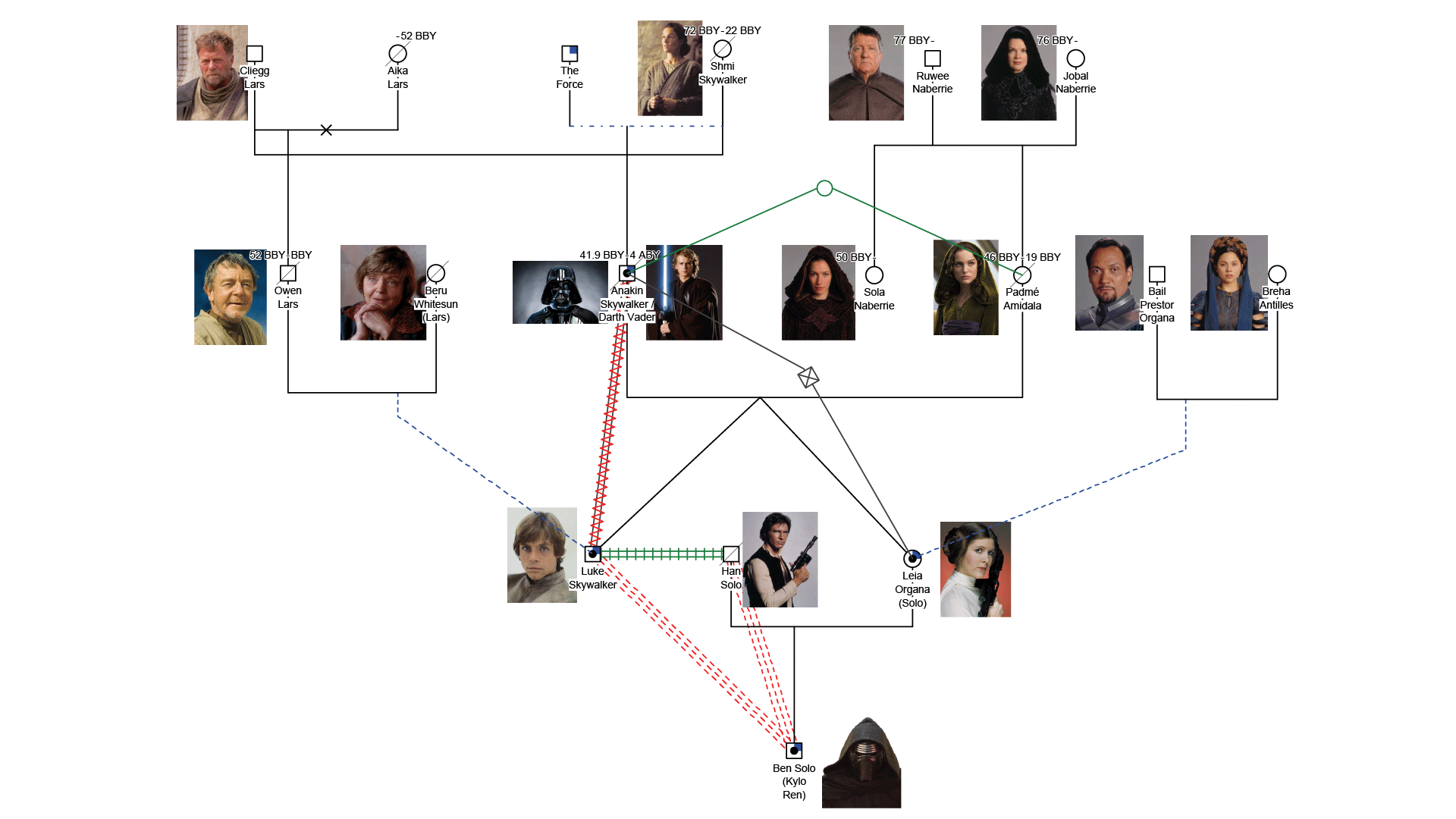
Star Wars Skywalker family genogram
Let’s start by looking at Padmé’s family. Her father Ruwee represented by square, mother Jobal represented by a circle. She also has an older sister named Sola, we know she is older because she is to the left.
We can see that Padmé is in love with Anakin Skywalker who is the son of Shmi Skywalker and The Force.
Anakin and Padme have twins, Luke and Leia, however Anakin does not know this and does not know about Leia.
Luke is adopted by Owen Lars and Beru Whitsun. Owen turns out to be the son Of Cliegg Lars who married Anakin’s mother after Owen’s mother died.
On the other hand Leia is adopted by Bail Prestor Organa and Breha Antille and she takes the Organa family name.
Luke has a close violence relationship with his father, they fight every time they see each other.
Luke is friends with Han Solo who marries Leia and have a child named Ben.
Anakin, Luke, Leia, and Ben are strong carriers of Midi-chlorians, we can see a pattern from which we could begin to theorize that it is a hereditary trait.
 Star Wars Skywalker family tree
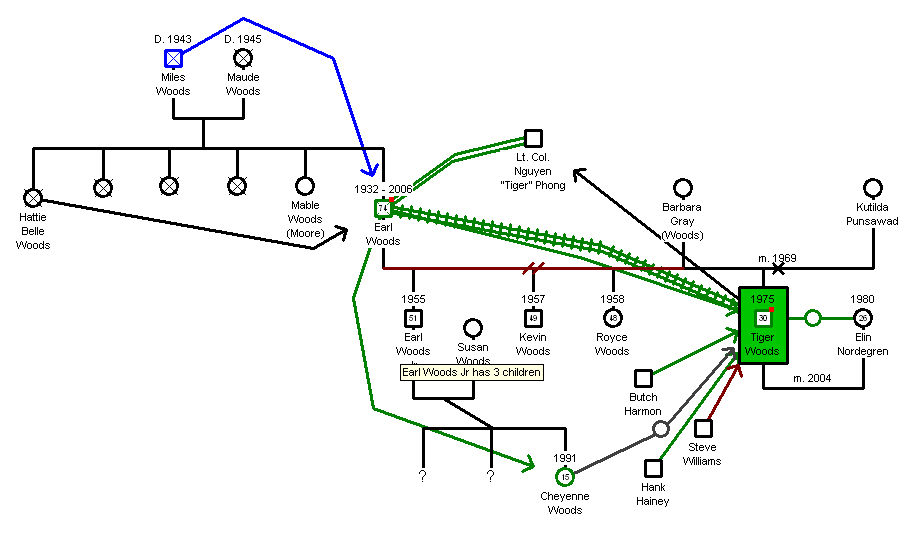
Tiger Woods genogram
The following example is of Tiger Woods, considered to be one of the best golf players ever. Tiger was the child of Earl
Woods and Kutilda Punsawad, from Earl Woods' second marriage. Earl Woods took special interest in his son, and was his first golf coach. Earl had
himself been coached by his father, only in baseball. Earl and Tiger had a unique father-son bond, and Earl was Tiger's greatest inspiration in
life.
 Tiger woods family tree
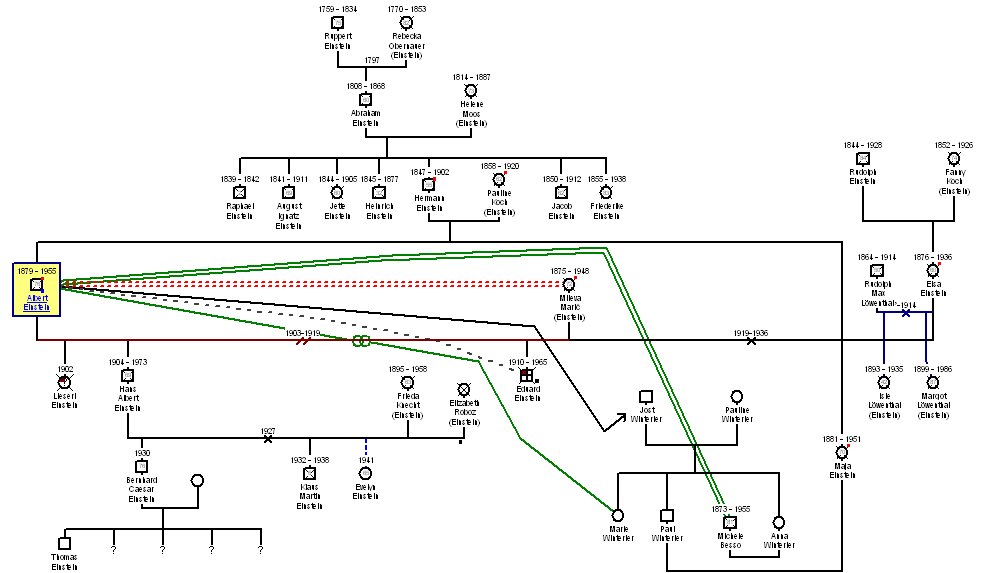
Albert Einstein genogram
This next example is the genogram of Albert Einstein's family. This genogram tried to answer the question, where exactly did
Einstein's genius come from? Well, this genogram does not reveal anyone of particular genius in the rest of his family, which may rule out the
genetic factor. An interesting factor is that one of his sons had schizophrenia, a mental disorder. Also, Einstein still has at least five
surviving descendants.
 Albert Einstein family tree
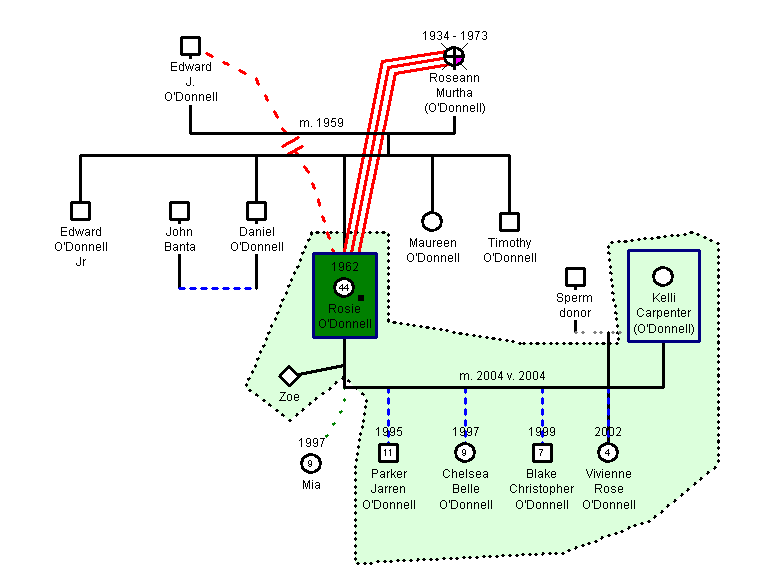
Rosie O'Donnell example
This example features a well-known television show host, Rosie O'Donnell, who is in a committed same-sex relationship with
Kelli Carpenter. She has adopted children, prior to her relationship, and her partner has given birth to a child who was conceived with
the help of an anonymous sperm donor during the term of this current relationship. Together with these children, and a dog names Zoe, they create
a household. Rosie also had a foster child named Mia, but she was taken away from her in 2001, so she no longer lives with her.
The genogram also demonstrates that Rosie had a fused relationship with her mother until she passed away at the age of 38 from breast cancer.
After that, Rosie grew estranged from her father who was not emotionally available for his children. Interestingly, her brother is also in a
committed long-term same-sex relationship.
 O'Donnell family tree
Fictional breast cancer study genogram
This last example is a fictional breast cancer study involving six families. In this study, a three-generational genogram was
created for the family of six women born in the early 1900s, and diagnosed with breast cancer before the age of 50. With these genograms, we can
easily see the incidence of breast cancer and ovarian cancer in the descendants because of the medical symbols
provided. Researchers can add important details, such as the age of diagnosis, the age at death, the type of cancer, the location of the cancer
(left, right, bilateral), etc., and display them on the genogram to facilitate interpretation of the data.
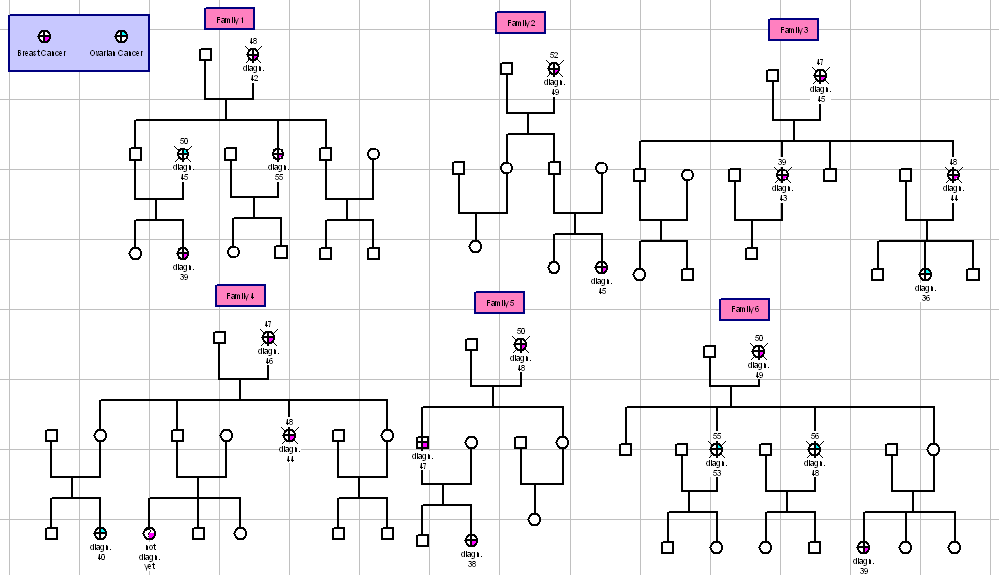 Breast cancer study genogram
Previous: Introduction to genograms
Next: Genogram symbols